

Recently, one of my students inspired me to write this blog. While many people travel to the United States to see iconic landmarks or experience American culture, this student’s trip had a very different purpose. Their family travelled to New Haven, Connecticut, not for sightseeing, but to visit universities and explore future study opportunities. It was a reminder that for many families, the journey to university begins long before applications are submitted.What made the moment even more special was reflecting on how far they had come. This particular student has been taking online English lessons with me for the past seven years, steadily building the language skills and confidence needed to pursue such an ambitious goal. It was a powerful reminder that preparing for university begins years before applications are submitted.
If your child dreams of studying at a university in the United Kingdom or the United States, one of the most valuable things you can do as a parent is understand the role of English proficiency exams—and, more importantly, how much preparation they require. These are not exams that can be passed with a few weeks of last-minute revision. The scores expected by top universities are built through years of consistent, high-quality English learning, with vocabulary, grammar, reading, writing, listening, and speaking skills developed gradually over time.
Why planning ahead matters
Most French children learn English at school, but the gap between standard school-level English and the C1 or B2+ level required by universities in Oxford, London, or New York is substantial. Universities like UCL, King’s College, or NYU typically require a score equivalent to CEFR level C1 — which means your child needs to be able to read complex academic texts, write structured essays in English, follow lectures, and hold sophisticated conversations, all under exam conditions.
A realistic preparation timeline
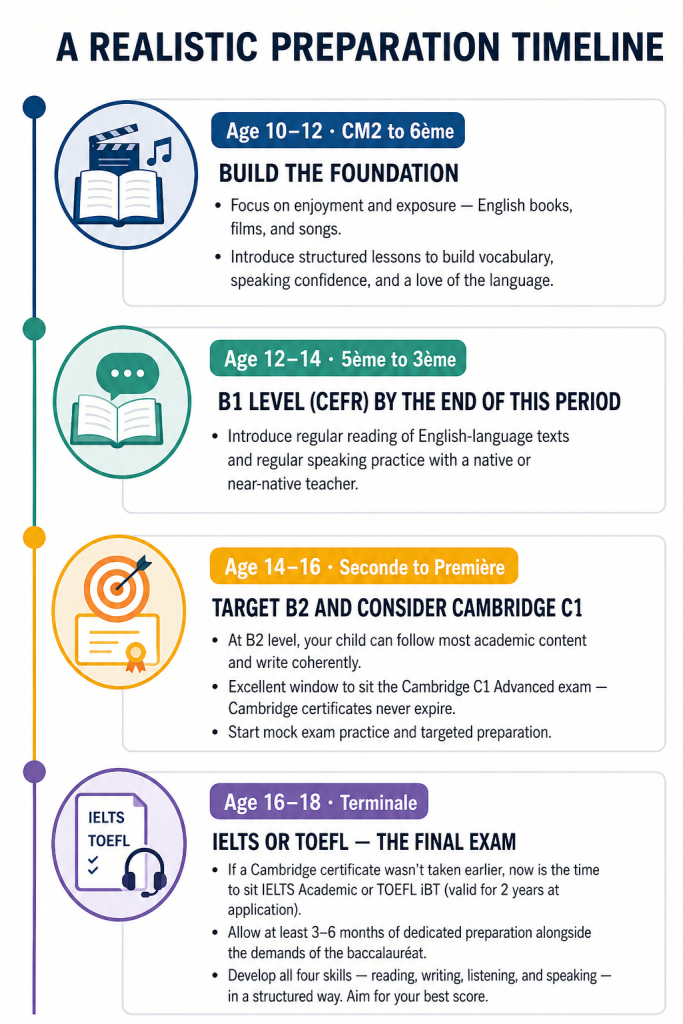
The three exams that matter most
IELTS Academic
UK & US universities – Most widely accepted
IELTS Academic is the single most recognised English qualification in the world and the default requirement at UK universities. American universities increasingly accept it too, making it the safest single exam if your child is applying to both countries. The test covers four skills — listening, reading, writing, and a face-to-face speaking interview with a human examiner. Most competitive universities ask for a minimum band of 7.0, with some programmes requiring 7.5. A band 7 student reads and writes at a high academic level and speaks fluently with only occasional imprecision.
Parent planning note: Because IELTS is only valid for two years, your child should sit it no earlier than two years before their university start date — typically in Year 12 or 13 (Première or Terminale). Aim for at least six months of focused preparation beforehand.
TOEFL iBT
US universities
TOEFL is the preferred exam for American universities and is entirely computer-based, including the speaking component, which is recorded rather than delivered to a live examiner. This makes it feel less intimidating for some students. TOEFL is designed around academic English tasks — reading passages from university textbooks, listening to lecture extracts, and writing responses that integrate multiple sources. The exam combines different language skills in tasks that reflect real-life academic situations, although this integrated approach can feel challenging for some students.Selective US universities typically require a score of 100 or above out of 120.
Parent planning note: If your child’s goal is specifically an American university, TOEFL is the natural choice. If they are keeping options open across both countries, IELTS covers both markets more reliably.
Cambridge C1 Advanced & C2 Proficiency
UK universities
Cambridge qualifications carry a unique and enormously valuable advantage for families planning ahead: they never expire. Cambridge certificates are accepted by UK universities and institutions across Europe. C2 Proficiency is the highest level available and signals near-native mastery of the language.
Parent planning note: This is the strategic choice for long-term planners. If your child reaches B2 level by age 14–15, preparing for Cambridge C1 in Year 10 or 11 is highly recommended. One exam, done once, valid forever — the stress is removed entirely from the crucial Terminale year.
The exam is just the finishing line.
What wins the race is everything that comes before it, the years of speaking practice, the books read in English, the essays written and corrected and written again. Whichever certificate your child ultimately needs, the path to it is the same: start early, stay consistent, and trust that the work compounds. Your child’s place at a British or American university is not a distant dream. It is a plan and this is where it begins.